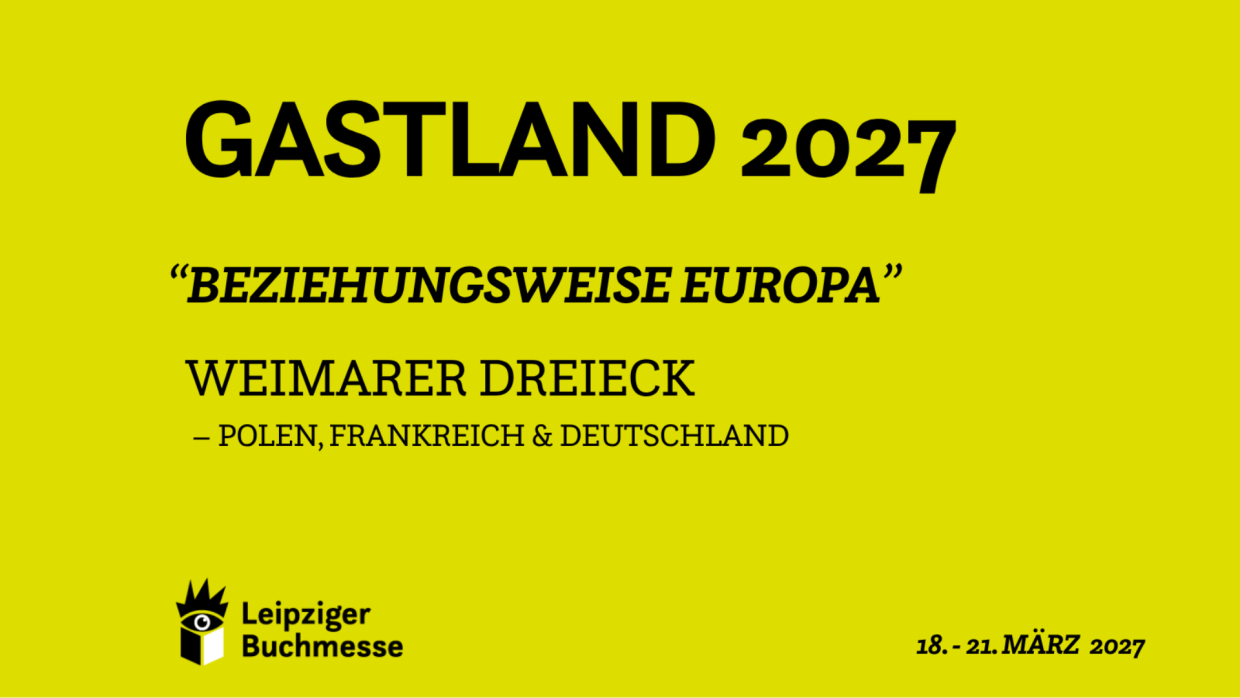

'Beziehungsweise Europa': Guests of Honour – Poland, France and Germany at the 2027 Leipzig Book Fair
For the first time in the history of the Leipzig Book Fair, three countries – Poland, France and Germany, also known in the political sphere as the Weimar Triangle – will be appearing together as joint guest countries in 2027. The programme is being organised by the three countries’ cultural institutes – the Polish Institute, the Institut français and the Goethe-Institut.
Together with the curator Thorsten Dönges (Literarisches Colloquium Berlin), Myriam Louviot (Institut français), Karolina Golimowska (Polish Institute) and Wolf Iro (Goethe-Institut) are currently developing a programme entitled ‘Beziehungsweise Europa’, which brings together literary perspectives from Poland, France and Germany whilst also providing impetus for current social debates in Europe. It aims to spark curiosity – curiosity about one another, curiosity about literature and curiosity about the exchange of ideas and perspectives.
The word ‘beziehungsweise’ combines the concepts of ‘relationship’ and ‘wise’. The Weimar Triangle’s appearance at the 2027 Leipzig Book Fair will focus on the relationships that link the three countries and societies, whilst also exploring other relationships – such as those between academia, literature and the other arts; between literary genres; between history and tradition; between humanity and nature; and between technology and the media.
The Weimar Triangle is, by its very nature, a political concept: Poland, France and Germany have committed themselves to jointly strengthening and further developing the European ideal. Since its establishment in 1991, the Weimar Triangle has stood for dialogue, mutual understanding and shared responsibility for the future of Europe.
What issues are shaping public debate in Poland, France and Germany? What have been, and what are, the conditions for understanding and reconciliation? How do trust, but also mistrust and misunderstandings, arise? What role do history and perceptions of history play in current debates? The programme explores how we can shape the future together and how we can better address crises and fears. Furthermore, it examines the influence of new technologies on society, politics and literature, the genres currently shaping the book market, and the question of how the significance of art and literature is changing from the perspective of a young audience.
The programme deliberately moves away from the traditional concept of a ‘guest country’ and from the notion that there are supposedly homogeneous national literatures. Rather, the aim is to read between the lines, across languages, and beyond all attributions of identity. The joint guest country programme emphasises that exchange, solidarity and cooperation are more important than ever.