


A Stream of Stories: Fascinating literary insights along the Danube
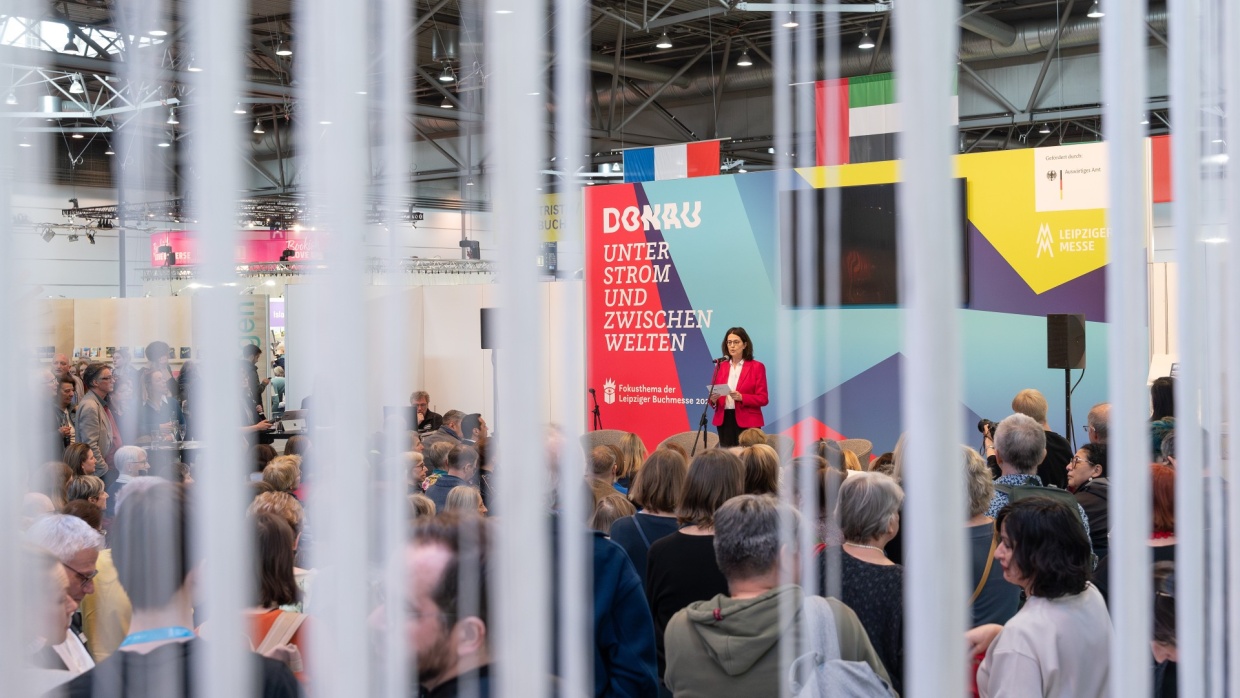
It flows through Vienna, Budapest and Belgrade, connects ten countries, unites a turbulent past – and carries a wealth of stories with it. Over four days, exhibition visitors were able to immerse themselves in a region as multifaceted as it is fascinating, as part of the focus theme ‘The Danube – Flowing and Bridging Worlds’. The audience was thrilled, creating a huge crowd in front of the 'Donau-Bühne' [Danube Stage].
At around 87 events – 33 of which took place on the 'Donau-Bühne' in Exhibition Hall 4 – authors from the Danube region brought to life a region that continues to shape Europe and its people to this day. Even the opening of the exhibition stand showed that this year’s featured topic attracted the guests. Many arrived with a wealth of knowledge about the region, as demonstrated by the Danube quiz at the start of the event, where correct answers offered the chance to win one of the latest publications.
Astrid Böhmisch, Director of the Leipzig Book Fair, summed up why the Danube region is so fascinating from a literary perspective: “In the countries through which the Danube flows, political systems, national borders and even national languages have changed over the centuries. Disruptions were and remain the norm; identities have been redefined. Many of the books in our feature topic deal with these issues. They show just how inspiring literature can be, and how powerfully it can foster understanding.” Christina Beinhoff, Head of Culture and Society at the Federal Foreign Office, added a political perspective: “Peaceful coexistence in Europe can only succeed if we continue to engage in dialogue, despite all our differences and especially at times when it would be easier to turn away. Literature is a particularly effective means to this end. For societies that read together are harder to divide.”
Serbian author Marko Dinić, whose "Buch der Gesichter" (Zsolnay) was shortlisted for the 2025 German Book Prize, and Kosovar poet Blerina Rogova discussed at the 'Donau-Bühne' how one might carry on living in the wake of a war-torn state of disaster. Rogova reported that, following the Kosovo War, there had been a widespread reluctance to remember. It was only with time that the need to come to terms with the past grew. For Dinić, this is where literature comes in: “As an author, you write to combat forgetting. It is a small contribution towards rousing people who suffer from collective amnesia.”
Understanding the past in order to shape a better future: this was also the focus of the conversation between Ena Katarina Haler, who attended the Book Fair to promote her new novel "Die Schuldlosen" (folio), and Bojan Krivokapic (most recently "Villa Fazanka", eta). Both the Croatian author and the Serbian author write about border regions, scarred landscapes and destroyed homes – and about people who have experienced loss and are searching for answers. “This is where literature helps to foster empathy and heal wounds,” said Haler.
From experiences of war, flight and identity, to the Danube as a habitat: the 'Donau-Bühne' created a narrative that stretched far beyond the river’s banks, drawing the audience into stories that are just waiting to be heard – and perhaps to be learnt from.